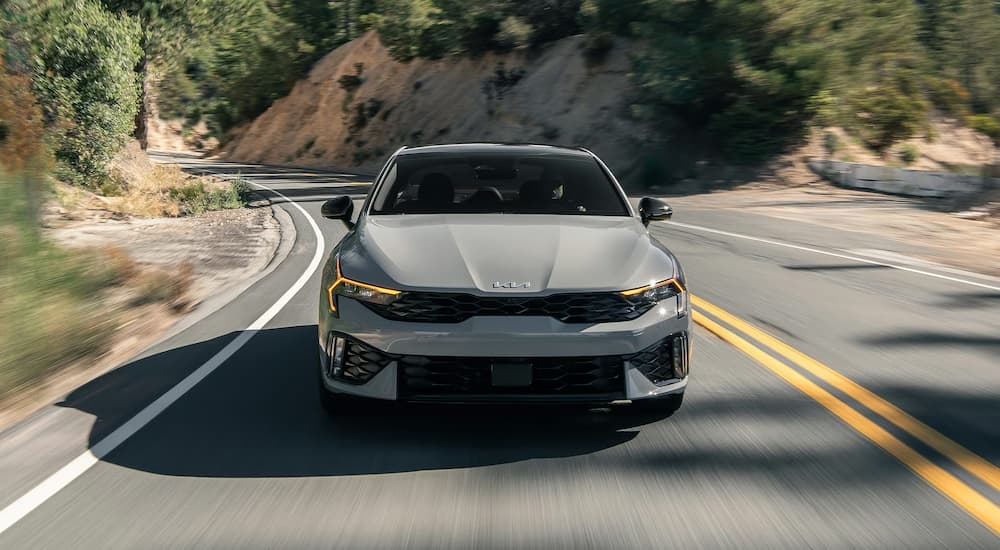
The 2026 Kia K5 represents a stylish alternative to your typical midsize sedan. Perfect for young professionals, small families, and other drivers who want to stand out on their morning commute, the sleek, sporty K5 offers a premium driving experience at an affordable price. The K5 debuted for the 2021 model year, replacing the less exciting Kia Optima. While it might slot into the same midsize segment, the K5 represents an entirely new take on the category with its athletic design, powerful turbocharged engine, and a modern interior that includes the latest in comfort, convenience, and infotainment technology.
While it might be one of the more eye-catching options on the market, the K5 faces some stiff competition from some of the segment’s perennial favorites, including the Toyota Camry. So, how does the car compare with the popular Toyota model in terms of performance, style, and fun, and why should drivers consider a Kia K5 for sale? We’ll break it down as we pit the 2026 Kia K5 against the 2026 Toyota Camry.
No Substitute for the GT
The K5 and Camry both employ a 2.5L four-cylinder engine, but that’s where the similarities end. While Toyota has opted for a hybrid engine across the board, Kia has adopted a more traditional approach that allows the K5 to deliver a more exciting ride, especially when opting for the performance-focused GT trim. The K5’s sportiest guise sees the 2.5L engine paired with a turbocharger to create a 290 hp sedan that you won’t soon forget. That’s enough muscle to move the K5 GT from zero to 60 mph in just 5.3 seconds, which is a full 1.7 seconds faster than even the speediest Camry.
The GT makes the most of its turbocharged engine with a sport-tuned suspension that allows the car to be just as responsive as it is powerful. Firmer springs and dampers significantly sharpen the K5’s handling while still providing plenty of comfort in everyday driving scenarios. The K5’s base engine offers a more subdued 191 hp, but makes some important gains in the efficiency department with an EPA-estimated 30 MPG combined. It’s hard to find fault with the K5’s powertrain options, as it delivers a well-rounded mix of performance and efficiency that’s sure to satisfy even the most discerning driver.
The Camry’s hybrid engine can be optioned with either two or three electric motors, which produce up to 232 hp but lack the acceleration potential of the K5. It’s a decent showing for the Toyota, but it's not the sort of performance that’s going to have you looking for a more scenic route to your destination.
Where is the Camry’s competitor to the K5 GT? You’ll find that it was retired after the 2024 model year. The Camry TRD had provided Toyota drivers with a potent alternative to the standard model, featuring a 301 hp V6 engine, sport exhaust, and sport-tuned suspension. However, sadly, the sporty trim didn’t survive the Camry’s shift to hybrid technology.
Instead, there is the new Nightshade trim, which is basically the TRD minus any of the actual performance upgrades. The model might look the part with its 19-inch black-finished wheels and gloss black exterior trim, but the sedan’s performance credentials simply don’t extend beyond the surface level.
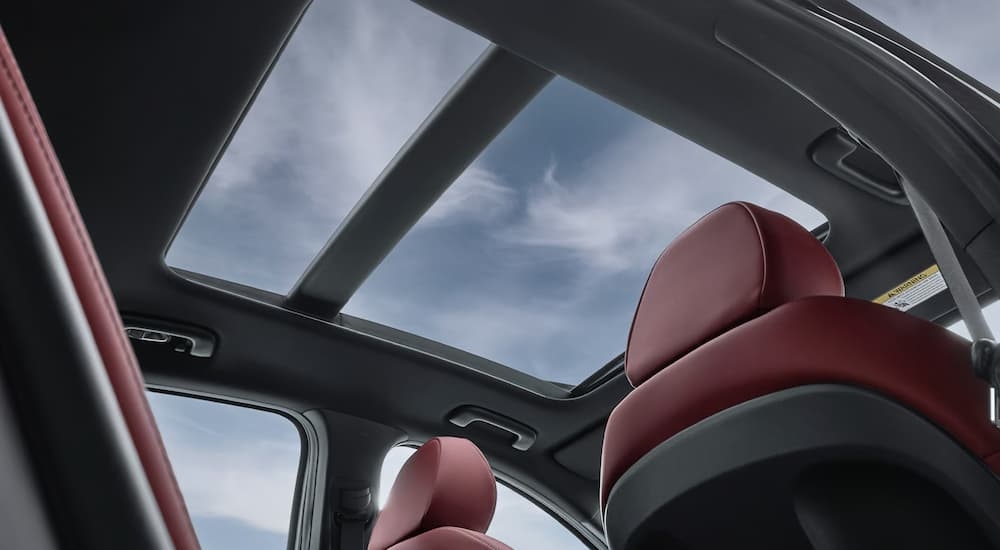
A More Engaging Experience
The K5 might best the Camry in terms of pure performance potential, but that is not the end of the story. Kia’s midsize model also holds a key advantage over Toyota’s contender when it comes to the transmission. While the 2026 Camry employs a rather lethargic electronically controlled continuously variable transmission (eCVT), the K5 can be had with your choice of automatic options. An eight-speed automatic handles the power distribution duties on most of the 2026 K5 trims, but opting for the GT model sees the traditional transmission swapped out with a sophisticated eight-speed dual-clutch transmission (DCT) that allows drivers to enjoy the best aspects of both the automatic and manual approaches.
The DCT can operate like an automatic when you’re looking for a low-effort driving experience, but if you want to ramp up the fun factor and put the 290 hp GT through its paces, simply tap the steering wheel-mounted paddle shifters, and you’ll be able to select the right gear for the current scenario. Downshifting gives drivers the opportunity to generate a little extra power as they exit a corner or minimize wear on their brake pads through the use of engine braking, while upshifting can have a noticeable impact on fuel economy. It’s a clever bit of driving technology often found in high-end sports cars, and it helps to set the K5 apart in a competitive segment.
There’s nothing wrong with the Camry’s eCVT—the design is actually pretty common among hybrid vehicles—but it suffers from many of the same shortcomings as the continuously-variable transmissions found in many of today’s low-price cars. It largely comes down to a lack of responsiveness and the absence of the traditional shifting sensation that’s such an important part of creating a strong connection between a driver and their vehicle.
Sure, the eCVT’s planetary gearset maximizes efficiency, but it can be a little underwhelming for those who are accustomed to a more traditional setup. eCVTs are also relatively new, which means that they can be expensive to fix should something go wrong. It’s clear that Toyota prioritized efficiency over performance when designing the Camry, so while it’s easy to pick on the tedious eCVT, it all comes down to a difference in automotive ethos.
Style That Can’t Be Ignored
While taste is subjective, it’s hard to make an argument against the Kia K5 being the most stylish midsize sedan on the modern market. A comprehensive refresh back in 2025 saw the K5 transformed inside and out, and the results speak for themselves. It all starts at the front, where the K5 gets the chance to show off Kia’s innovative new Star Map Signature Lighting. The ultra-thin amber daytime running lights are arranged in a jagged lightning bolt shape, providing the K5 with an aggressive look. When paired with the inset LED headlights, this design almost makes it seem like the Kia is staring you down and daring you to make the first move.
That’s no coincidence, as Kia has been championing a unique “tiger face” design since the debut of the K5 back in 2021. A logical extension of the original “tiger nose” grille introduced by famed German designer Peter Schreyer, the tiger face look is created by the K5's wide, thin grille and unique headlights.
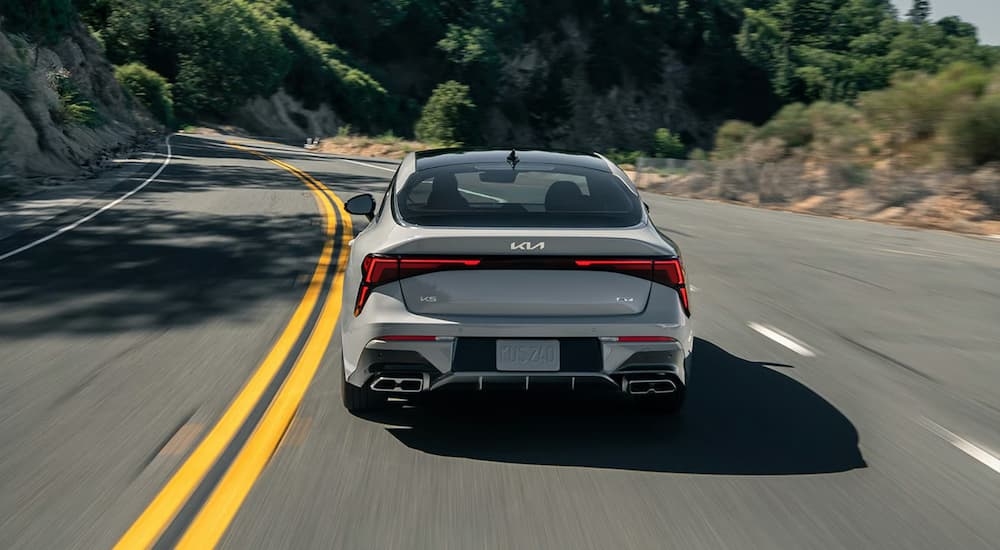
The Star Map approach is carried over to the taillights, creating a cohesive, futuristic aesthetic. The K5 also leverages a fastback-style roofline that makes the sedan look speedy even when it’s sitting still, underscoring its performance potential. Other highlights include an available quad-tip exhaust system and new alloy wheel designs that significantly enhance the K5’s curb appeal. The K5 takes some bold chances and is all the better for it, boasting a distinctive design that immediately sets it apart from some of the segment’s more conservative models, such as the Camry.
Park the 2026 Camry next to the K5, and you risk fading into the background. The Camry was also redesigned for the 2025 model year, but Toyota took a lighter touch in refreshing its own midsize offering. Kia is not alone in drawing inspiration from the animal kingdom for its designs, with the Camry kicking off its ninth generation featuring a new “hammerhead” front fascia that also lends the car a sporty, contemporary look. The automaker gets points for trying, but there is one element that’s sure to prove a bit polarizing from a design perspective: the upsized lower intake.
The enormous intake detracts from the Camry’s sporty look, making it appear less aerodynamic, slightly outdated, and somewhat reminiscent of a cheese grater. The Camry’s silhouette remained largely unchanged through the 2025 redesign, although it did gain some sharper bodyside creases, rounder body panels, and new lettering across the decklid. In many ways, Toyota’s cautious approach to car design is understandable. The Camry is one of the brand’s best-selling models, but that sort of popularity comes with some downsides. Toyota needs to ensure the sedan appeals to a wide swath of buyers, which means it simply can’t take the same risks as a model like the K5.
Catch the K5 at Parkway Family Kia
The K5’s bold style, refined interior, and satisfying GT trim make the model difficult to ignore, but it’s Kia’s generous warranty program that really seals the deal. Kia offers one of the most comprehensive warranties on the market, providing drivers with priceless peace of mind that’ll have you confidently navigating highways, byways, and detours for years to come. The 10-year or 100,000-mile powertrain warranty safeguards many of the car’s most expensive components, reducing the likelihood of a hefty repair bill and allowing drivers to test the car’s mettle without having to worry about ending up in the shop.
An additional limited warranty provides a second layer of protection for the first five years or 60,000 miles of ownership, and speaks to Kia’s confidence in its design and production process. The Camry’s own warranty coverage is a bit thin in comparison. While all hybrid components are covered for eight years or 100,000 miles, Toyota’s powertrain and limited warranties are limited to 60,000 and 36,000 miles, respectively. Add the K5’s superior performance, engagement, and style, and it’s hard to see why drivers would settle for the Camry.